This year's calendar is particularly special to me and my family, as I've included a tribute to our precious daughter, Amelia Rose Meade. Amelia had a number of complex illnesses that were not recognised or treated in time. She died on 6 September this year, shortly before her 24th birthday, having spent the last 23 weeks of her life in hospital, suffering horrific pain, unable to eat or drink. A true nightmare for us all…but her bravery, stoicism and resilience was beyond incredible and breathtaking to the end. The love she showed us will stay with us forever. We miss her so much, but she is no longer in pain.
During this terrible time, we made contact with other families whose daughters have either suffered similarly or passed away. We have also found organisations and trusts that are working to raise awareness of these complex illnesses. Below is information/links to some of these little-understood illnesses.
Foremost, we recommend the RNZ podcast All In Her Head, a narrative investigation into EDS (Ehlers-Danlos Syndrome), presented by Anusha Bradley, 2025 NZ Journalist of the Year. This is also promoted on an extremely important website called Ruby's Voice. A Trust was established after the death of Ruby Hill by her amazing mother, Jo Hill, among others, and supports investigations into EDS and gastroparesis. “Through Ruby’s Voice we hope to enlighten health professionals by sharing Ruby’s story directly. A real story with devastating consequences but hopefully a story that will bring enlightenment and change for so many people in similar situations.”

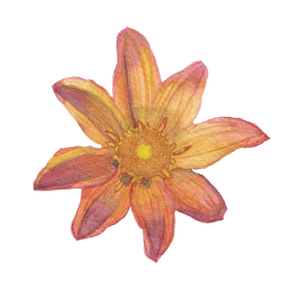
Amelia was astonishingly creative with watercolour paintings and pencil drawings. This is Amelia’s unfinished watercolour painting of a Pink Princess lavender. This will soon be available for sale as an A5 watercolour print on my website, along with other amazing images she created.
© The Estate of Amelia Meade
We haven’t met anyone else who has had the multiplicity of illnesses all at once that Amelia endured. So here’s a start:
EDS (Ehlers-Danlos Syndromes) is a group of inherited connective tissue disorders that affect the body's collagen, which provides strength and support to skin, joints and other tissues. EDS can cause joint hypermobility, instability, frequent dislocations, chronic pain, fragile skin and a range of other symptoms. The effects vary considerably between individuals. The condition can be complex and, for many, significantly affect everyday life. EDS in New Zealand: Ruby's Voice shares information and personal experiences relating to EDS and associated conditions. EDS: The Ehlers-Danlos Society provides international information and resources about the different types of EDS.
Gastroparesis (Delayed Gastric Emptying): A chronic digestive disorder in which the stomach empties food into the small intestine much more slowly than normal, due to impaired functioning of the stomach muscles and the nerves that control them. There is no physical blockage. Symptoms include persistent nausea, vomiting, abdominal pain, bloating, loss of appetite and feeling full after eating very little. In more severe cases, maintaining adequate nutrition and hydration can become difficult, significantly affecting everyday life. The underlying cause is often unknown, and the condition can be particularly challenging when combined with other chronic illnesses. More information here.
MCAS (Mast Cell Activation Syndrome) is a condition in which specialised immune cells, called mast cells, release chemical mediators inappropriately or excessively, causing a wide range of symptoms affecting different parts of the body. MCAS: International research and information from Mayo Clinic Laboratories.
ME/CFS (Myalgic Encephalomyelitis / Chronic Fatigue Syndrome) this is a complex, chronic illness that can cause profound exhaustion, unrefreshing sleep, cognitive difficulties and worsening symptoms following even minor physical or mental activity.ME/CFS: Know ME/CFS.
POTS (Postural Orthostatic Tachycardia Syndrome): a condition affecting the autonomic nervous system, in which the heart rate increases abnormally on standing, often causing dizziness, palpitations, fatigue and difficulty remaining upright. POTS: Healthify NZ.
VCS) Vascular Compression Syndromes): A group of conditions in which blood vessels, or sometimes nearby organs and structures, are compressed by surrounding arteries, veins, ligaments or other anatomical structures. This can interfere with normal blood flow or the passage of food through the digestive system, causing symptoms such as abdominal or pelvic pain, nausea, vomiting, bloating, circulation problems and fatigue. Rare Disorders NZ A glossary of VCS conditions is listed at the end of this informative Sara’s Story.
We hope that by providing this information, you will be more prepared to deal with medical professionals, some of whom are not well-versed in these conditions. Our aim is for our precious daughter’s life and death to make changes in the health system so that others do not suffer as she did. If you know anyone who may have one or some of these conditions, please seek medical help, and keep asking until someone listens to you.
Some of the recognised VCS - Vascular Compression Syndromes include:
MALS (Median Arcuate Ligament Syndrome): Compression of an artery supplying the upper abdominal organs, which can cause abdominal pain, particularly after eating, nausea and weight loss.
SMAS (Superior Mesenteric Artery Syndrome): Compression of part of the small intestine (the duodenum) between two major blood vessels, potentially causing digestive obstruction, pain, nausea and vomiting.
NCS (Nutcracker Syndrome): Compression of the left renal vein, which carries blood away from the kidney, potentially causing flank or pelvic pain and blood in the urine.
MTS (May-Thurner Syndrome): Compression of the left iliac vein, which returns blood from the leg towards the heart, potentially causing leg swelling, pelvic discomfort and an increased risk of blood clots.
Importantly, vascular compression syndromes are sometimes discussed alongside hypermobile Ehlers-Danlos Syndrome (hEDS) and other connective tissue disorders. However, the relationship is not yet well established scientifically. The Vascular Society of Aotearoa New Zealand has published a position statement discussing this issue. Read the NZ Vascular Society position statement. Not everyone with anatomical compression develops symptoms. Diagnosis requires consideration of symptoms alongside appropriate imaging and clinical assessment.